Virginia Commonwealth University's School of Business runs an Executive MBA built around what it calls transformative leadership, taught through its Institute for Transformative Leadership and a dedicated three-course sequence. This guide explains what that actually means - based entirely on VCU's own public materials (the Institute's website, the Executive MBA program page and brochure, the course catalog, and the 2026-27 Graduate Bulletin) and the peer-reviewed research those materials connect to.
Nothing here reproduces VCU course assignments, slides, or proprietary materials - only publicly available program descriptions, analyzed and cited.
Sources verified July 28, 2026. The 2026-27 VCU Bulletin was still labeled preliminary at that date, with a final edition expected in August 2026; this guide will be re-verified against the final edition once published.
What VCU explicitly says
VCU doesn't publish one sentence labeled "the definition of transformative leadership." Its own language, pieced together from its public sources, describes leaders who ensure others feel valued and belong, act with intention, and build deep, compassionate relationships. The Institute is explicit about a specific order of operations: leadership instruction "begins with the creation of caring and compassionate relationships," and technical practices - feedback, planning, difficult conversations, change - are then aligned through understanding, courage, and connection into what VCU calls compassionate accountability.
That sequencing shows up concretely in the curriculum. The Executive MBA's 42 credits include three required one-credit courses that VCU's course catalog describes in unusually specific terms:
- FMBA 620 (Foundational Concepts) covers self-awareness, mindfulness, emotional intelligence, authenticity, values, courage, communication, and relationships - the leader's own inner capacity.
- FMBA 621 (Applying the Concepts) moves to performance: expectations, feedback, coaching, delegation, conflict, trust, psychological safety, ethics, and culture.
- FMBA 622 (Organizational Excellence) extends to strategy, change, crisis, resilience, innovation, belonging, and systems thinking.
VCU's brochure frames this as pursuing "high levels of both care and accountability," reinforced by a cohort model, a consulting project every semester, executive coaching, simulations and assessments, a capstone strategic dilemma, and global immersion. Archived course catalogs show this dedicated three-course sequence appearing by the 2025-26 academic year - it doesn't appear in the 2023-24 or 2024-25 catalogs reviewed - which supports describing it as a recently formalized curricular architecture, not a claim that VCU's interest in human-centered leadership started only then.
VCU's materials never describe "transformative leadership" as a proprietary, branded model with a validated scale attached to it, and no public source states that VCU has formally validated it as such. It reads as the umbrella term the Institute uses for its own synthesis, not a claim of a single, official, measured theory.
MBA Lab's interpretation
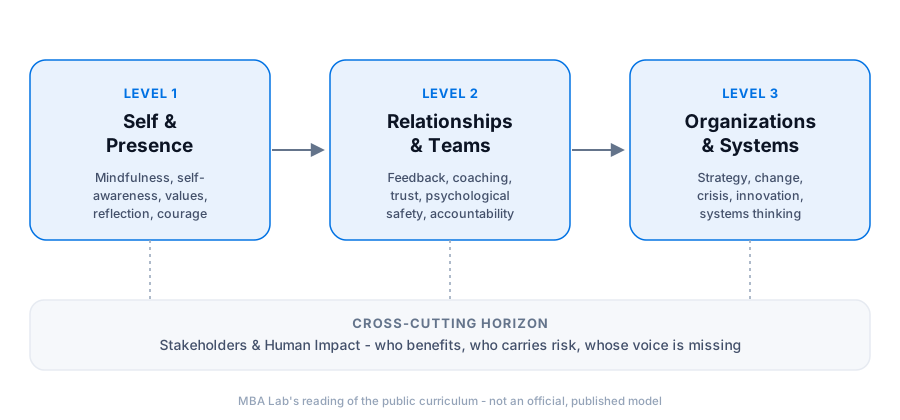
VCU doesn't publicly label its own curriculum as a formal "three-level model" - but the course sequence maps onto one clearly enough that it's a useful way to understand the whole approach. This is MBA Lab's reading of the public curriculum, not a VCU-published framework:
Level 1 - Self and presence (explicit focus of FMBA 620): the leader as an instrument of attention. Mindfulness creates a gap between stimulus and response; self-awareness and emotional intelligence shape how a leader reads a room before acting in it.
Level 2 - Relationships and teams (FMBA 621): the recurring work of management - setting expectations, giving feedback, coaching, delegating, resolving conflict - done in a way that preserves dignity and voice while making standards real.
Level 3 - Organizations and systems (FMBA 622): connecting leadership to strategy, change, crisis response, innovation, and belonging, on the premise that interpersonal care alone can't fix a system built to produce overload or silence.
A theme runs across all three levels rather than sitting in just one: who benefits from a decision, who carries its risk, and what its effects are over time.
The clearest operational idea in VCU's public materials is the pairing of care and accountability as two forces that fail predictably apart and work together on purpose:
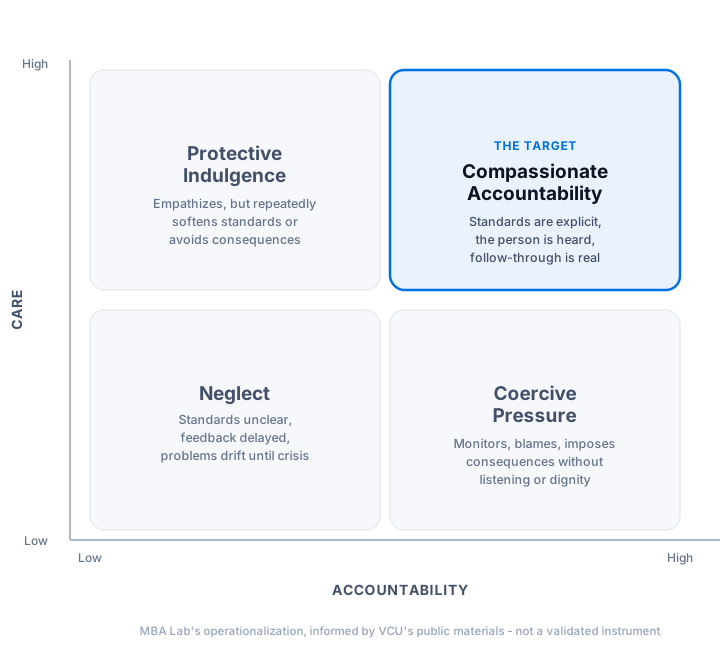
| Low accountability | High accountability | |
|---|---|---|
| High care | Protective indulgence - standards quietly erode to avoid discomfort | Compassionate accountability - standards and support coexist |
| Low care | Neglect - problems drift until they become a crisis | Coercive pressure - compliance without candor, information, or trust |
That compassionate-accountability quadrant is the goal VCU's materials describe. Because VCU doesn't publish a step-by-step protocol for it, MBA Lab has operationalized one from the Institute's own language about "understanding, courage, and connection" combined with standard practice in the feedback and psychological-safety research the curriculum draws on:
- Regulate before entering. Notice anger, anxiety, or the urge to rescue; decide what a values-consistent response requires.
- Separate facts from interpretations. Identify observable behavior, the agreed standard, and business impact - and what's still uncertain.
- State the standard and the impact. Be direct about what was expected, what happened, and why the gap matters.
- Invite the other person's perspective. Ask what they saw, intended, and experienced - genuinely, before concluding.
- Diagnose the system. Is this capability, clarity, capacity, motivation, role design, incentives, or coordination - not just effort?
- Agree support and commitments. Define what each side will do, by when, with what evidence.
- Specify review and consequences. Set checkpoints and explain proportional consequences if commitments aren't met.
- Follow through and learn. Review outcomes, reinforce progress, repair harm, and fix the system if it contributed.
VCU is explicit about what this is not: not delayed honesty (withholding feedback to preserve comfort), not forced vulnerability, not identical treatment regardless of context, not endless accommodation of repeated nonperformance, and not empathetic language unconnected to actual decisions or follow-through.
What broader research supports
Several pieces of this approach have real, independent research behind them, separate from anything VCU claims about its own program:
- Trust and psychological safety are among the most consistently supported links in the whole model. Meta-analytic research connects trust in leadership to performance and citizenship behavior, and connects psychological safety to learning, voice, and effectiveness (Dirks & Ferrin, 2002; Edmondson, 1999; Frazier et al., 2017).
- Leadership training and coaching, when well-designed - needs analysis, practice, feedback, spaced sessions - show positive average effects on learning and performance transfer (Jones et al., 2016; Lacerenza et al., 2017). This supports VCU's delivery design (cohort, coaching, real projects), not a specific claim about this program's effect size.
- Workplace mindfulness research supports attention, regulation, and some behavioral outcomes, though the literature is heterogeneous and quality varies a lot by intervention (Good et al., 2016; Eby et al., 2019).
- The Institute's founding director, Christopher S. Reina, has an active, relevant research program - on mindful attention in workplace interactions, how mindfulness buffers (but doesn't eliminate) the effects of daily work "hassles," and how leader mindsets shape development (Reina et al., 2023; Gupta & Reina, 2024; Gottfredson & Reina, 2021). This work is conceptually aligned with the curriculum; public materials don't establish that every study is directly taught in it.
- A separate conceptual paper on "humanistic organizing" (Town et al., 2024) offers a plausible academic bridge between individual mindfulness and organization-level change - but it's a theory paper proposing mechanisms for future research, not a completed evaluation of any program, VCU's included.
What remains unknown or unproven
This is where the evidence runs out, and it's worth being direct about it:
- No public, peer-reviewed evaluation of the VCU sequence itself was found. Program descriptions establish educational intent - what VCU is trying to teach - not proof that it works better than alternatives, or that it causes specific business outcomes.
- Selection effects are real. Executive MBA participants are experienced professionals who chose and could access an intensive program; any outcomes could reflect who enrolls as much as what's taught.
- "Transformative leadership" is not a single validated construct. It overlaps heavily with servant, authentic, ethical, mindful, and systems leadership traditions. That's not necessarily a weakness - integration can be a real strength - but it means there's no single instrument that measures "how transformative" a leader is.
- The approach can be misused. VCU's own model, read carefully, warns against exactly this: care curdling into paternalism or forced disclosure, "psychological safety" being confused with immunity from consequences, and mindfulness being used to individualize a problem that's actually structural overload.
- Cultural and organizational context matters. Direct feedback norms, hierarchy, and expectations about emotional disclosure vary widely; a model developed in one context doesn't automatically transfer everywhere unchanged.
When the model doesn't apply
Nothing above should be read as "every situation resolves through a conversation." VCU's own materials are explicit that safety events, active misconduct, legal exposure, or time-critical decisions call for decisive, sometimes unilateral action - and that care changes how that authority gets used (explaining the basis, protecting dignity, reviewing afterward), not whether it gets used at all.
The bottom line
Read carefully, VCU's public materials describe a distinctive applied synthesis - a specific sequence and delivery system built from mindfulness research, care-and-accountability practice, and systems thinking - rather than a single new, validated theory. The strongest, most defensible summary: VCU has built a coherent way of teaching leaders to hold care and accountability together; it has not published evidence that doing so causes specific organizational outcomes. Both of those things can be true at once, and treating the curriculum honestly means saying so.